.jpg)
OR, just have some fun!!
OR, just have some fun!!
Clearly, nothing stays the same over time! The videos of the gourd automatic made with online video services are now gone. In hindsight, they should have been made personally and relied upon an outside service. In the coming weeks, those automatons will be unboxed and reshot.
Life moves on - from reel to reel, to VHS tapes, to online video services. It just keeps moving on!


 In hindsight, the crank holes for each side should have been drilled before putting this together. By stacking the sides on top of each other, the drill could have done both holes at once. That way, the holes would be horizontal to each other. As of now, however, the sides will be attached to the base with dowels and glue, Then crank holes can be measured and drilled.
 Originally, I was considering doing a spin, a bobbing, and a jumping action. Since then I have learned a bit about eccentric and snail gears, and cranking actions. With an eccentric gear the 'center' hole for the turning shaft is off-center, giving a smooth up and down motion. Cutting the gear circle into more of a triangle or square shape but keeping the shaft hole in the center produces up and down motion, but more like a popping up and down....like jumping. That's the motion I want for one of these guys.
 |
| These are 3 sets of snap-apart gears. |
 OK, we have a plan for the improvised display dome to use with the gourd automata (well, the single ones -- not the multiple gourd automata). First, cut off the threaded top using a PVC pipe cincher. It makes clean cut and because it ratchets in steps, there is some control and very little leftover cutting debris. Once done, a spinner gourd makes a nice plug. Then, it is a simple matter of using an Xacto blade or scissors to cut the fluted bottom off to make the dome a suitable height for whatever it will be covering. The edge can nestled into a groove cut into a gourd base - awesome!
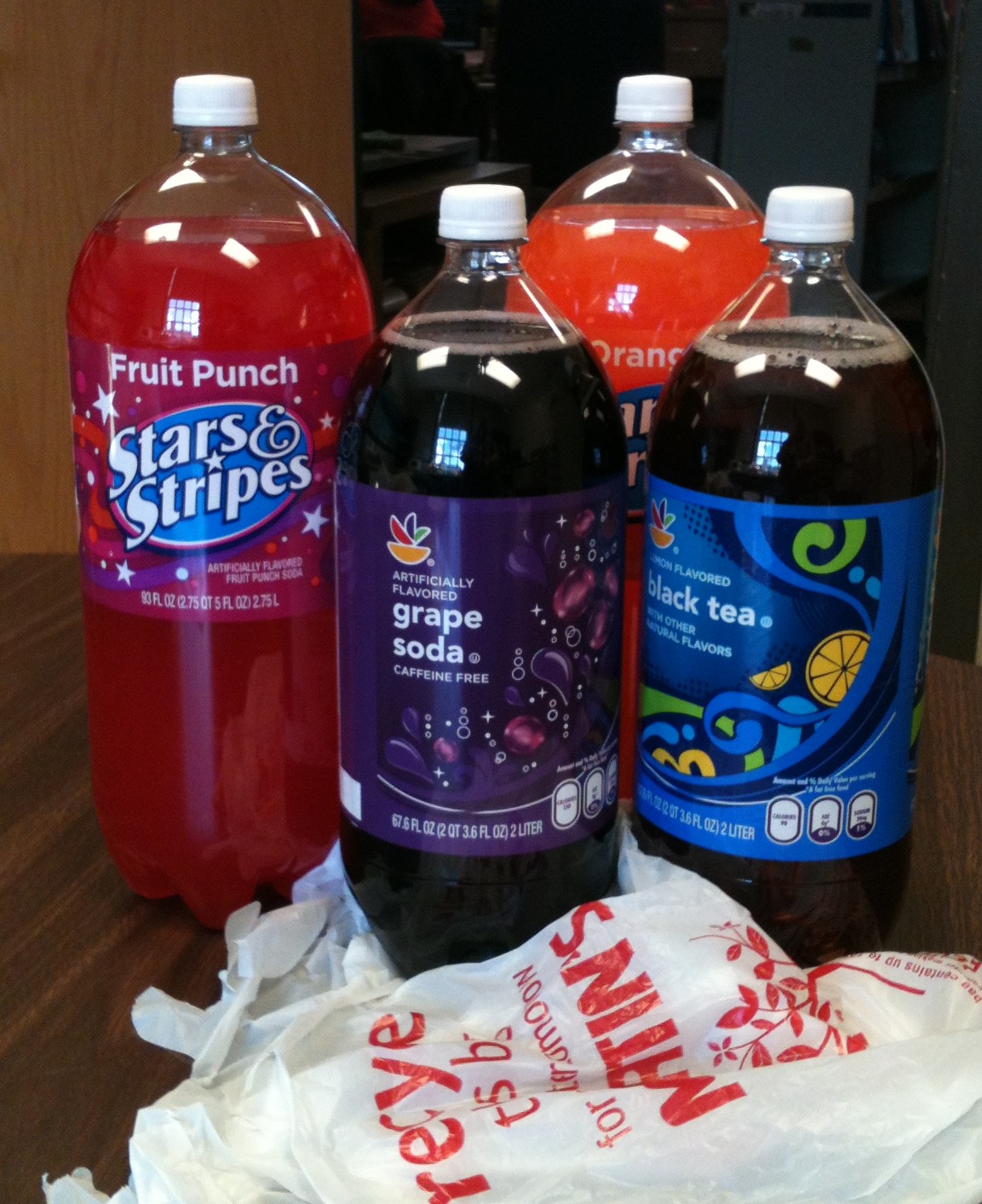 A quick trip to the local stores produced a couple options for the dome concept that could be applied inexpensively. They might actually allow a miniature bottleneck gourd turn and jump. An unexpected issue came to light once the soda was emptied out and the bottles washed -- the expiration date! Did not see that when the purchase was being made, MmMMmmmmm.
 What if the automata could be displayed carefully in a protected case with the crank extended through the case? Then, people can maneuver the crank, see the automaton move but it would still be protected from curious fingers and airborne dust. I am intrigued. American Science Surplus sells shadow boxes that could work for flat automata -- if I use really small gourds OR use flat gourd scraps. That is something to consider, but I want gourd dancers and chefs and pigs and chickens to spin and jump, and that takes more circumference space than a shadow box can afford.
  A glass display dome at National Artcraft is a possibility but geez! at $49 a piece, it would outclass the gourd! I like the size and diameter of the dome because it would accommodate a 3-d automata and could be turned around so the viewer can see all aspects of the construction, but then I come back to the price and consider how many ideas I want to pursue. Nice concept; not going to happen.
 Here are three movement possibilities for my gourd chickens. Each one will make a chick do something different. The round one will be the friction wheel for a horizontal disc so the chick spins, the oval/off-center cam will make a chick peck the ground like an oil derrick, and the sawtooth gear will have a chick jumping up and down and its follower (the rod connecting it) slides up and then bumps down the edge of each pointy tooth. They are all on the same shaft so as it is turned with a crank, the chicks will all move at the same time.